


Cinta adhesiva de doble cara vs. pegamento: ¿Cuál es mejor para el montaje industrial?
Release time: 2026-10-26
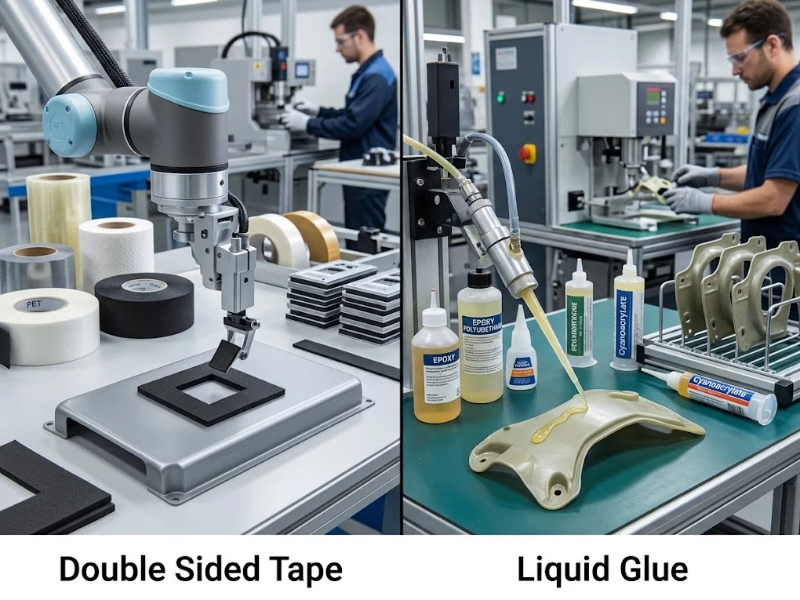
When choosing an adhesive for industrial assembly, many manufacturers face the same question: should you use double sided tape or liquid glue?
Both options can bond different materials, but they work in different ways. The right choice depends on the materials you’re joining, production speed, working conditions, and overall cost.
If you’re a manufacturer, distributor, or purchasing manager looking for a reliable bonding solution, here’s what you need to know before making a decision.
1. Double Sided Tape vs Glue: What’s the Difference?
Double sided tape has adhesive on both sides of a carrier, which may be made from materials such as foam, tissue, or PET film. It comes in rolls or custom-cut shapes, making it convenient for industrial assembly.
Liquid glue, on the other hand, is applied directly to a surface. Depending on the formulation, it may need time to dry or cure before the bonded parts can be handled.
The main difference is how they fit into your production process. Tape is generally easier to apply consistently, while glue can be useful when you need to cover irregular surfaces or create a continuous bond over a large area.
2. When Is Double Sided Tape the Better Choice?
For many industrial applications, double sided tape offers several practical advantages.
Faster assembly: Tape can be applied immediately without waiting for drying or curing. This helps reduce production delays and supports efficient assembly lines.
Cleaner application: Unlike liquid glue, tape usually creates less mess and doesn’t require brushes, dispensing equipment, or solvents for routine application.
Consistent bonding: With the right tape specification and application process, manufacturers can achieve repeatable results across large production batches.
Suitable for different materials: Depending on the adhesive type, double sided tape can bond plastic, metal, glass, wood, and painted surfaces.
Foam double sided tape is often used for mounting panels, signs, and components that need some cushioning. Thin PET or tissue tape may be more suitable for lightweight parts, labels, and precise assembly work.
For industrial buyers, selecting the right adhesive tape can also simplify inventory management and reduce the need for additional application equipment.
Explore the double sided tape and adhesive tape products at HylinnTape to learn more about available bonding solutions.
3. When Is Liquid Glue a Better Option?
Despite the advantages of tape, liquid glue still has an important role in industrial manufacturing.
For example, glue may be more practical when bonding porous materials, filling small gaps, or covering complex surfaces. Some specialized adhesives also provide excellent resistance to heat, chemicals, or long-term environmental exposure.
In certain applications, liquid glue can deliver a strong, permanent bond at a competitive material cost.
However, buyers should consider more than the price per unit. Application equipment, labor, curing time, waste, and quality control can all affect the total cost of the bonding process.
That’s why testing both options under actual production conditions is often worthwhile.
4. Which Option Is More Cost-Effective?
There is no universal winner. The more economical option depends on your production requirements.
| Factor | Cinta adhesiva de doble cara | Liquid Glue |
|---|---|---|
| Solicitud | Usually quick and simple | May require dispensing tools |
| Curing time | Usually no curing required | May require drying or curing |
| Cleanliness | Generally cleaner | Potential for spills and residue |
| Relleno de huecos | Limitado | Often better |
| Automation | Suitable for many assembly processes | Also suitable with proper equipment |
| Material cost | Varies by tape type | Varies by formulation |
For high-volume assembly, tape may help reduce labor and improve production efficiency. For applications requiring gap filling or specific chemical properties, glue may be the better solution.
The best comparison should include the total cost of application, not just the purchase price.
5. How to Choose the Right Bonding Solution
Antes de realizar un pedido al por mayor, tenga en cuenta estos cinco factores:
-
Substrate materials: Check whether the adhesive is compatible with the surfaces being bonded.
-
Surface condition: Smooth, rough, oily, and low-surface-energy materials may require different adhesive formulations.
-
Operating environment: Consider temperature, moisture, UV exposure, and chemical contact.
-
Bonding requirements: Decide whether you need permanent attachment, cushioning, flexibility, or gap filling.
-
Production volume: Choose a solution that fits your assembly speed, equipment, and labor costs.
It is also a good idea to test samples before committing to a large purchase. Surface preparation, application pressure, and bonding time can all affect the final result.
For additional technical discussions about adhesive selection and bonding challenges, you can explore the Adhesives and Sealants discussion community on Reddit.
Conclusión
So, is double sided tape better than glue for industrial assembly?
For applications that prioritize clean handling, quick installation, and consistent production, double sided tape can be an excellent choice. Liquid glue may be more suitable when gap filling, surface coverage, or specialized bonding properties are essential.
The key is to match the adhesive to your materials and production requirements rather than choosing based on price alone.
If you’re sourcing adhesive tape for industrial assembly, contact HylinnTape to discuss your application and explore suitable tape solutions for your business.

