


How Temperature Affects Adhesive Tape Performance
Release time: 2026-09-15
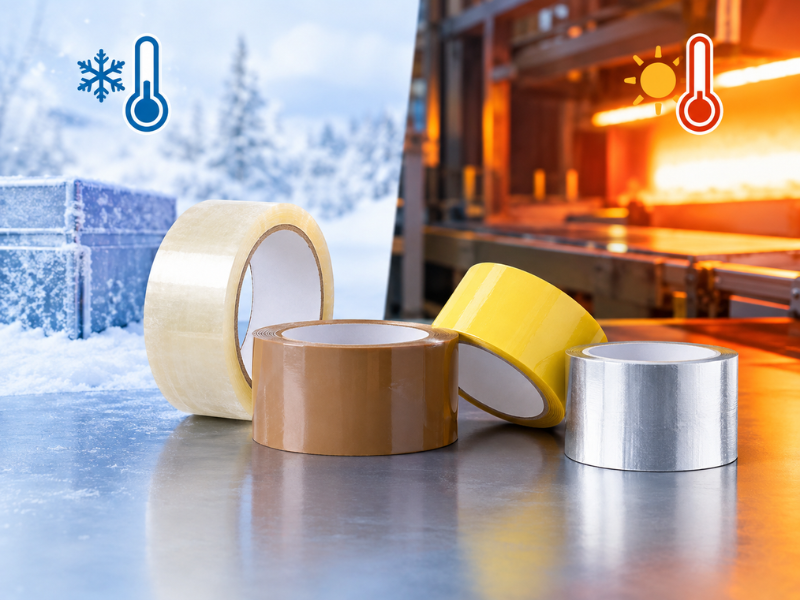
When choosing adhesive tape for industrial or packaging applications, temperature is one factor that is easy to overlook. A tape may perform perfectly in a warehouse or workshop at room temperature, but the same tape can behave very differently when exposed to freezing conditions, high heat, or repeated temperature changes.
For distributors, wholesalers, and industrial buyers, understanding how temperature affects adhesive tape can help prevent problems such as poor bonding, adhesive residue, edge lifting, or tape failure.
So, how does temperature actually affect tape performance?
Why Temperature Matters for Adhesive Tape
Most pressure-sensitive adhesive tapes rely on a balance between tack, flexibility, and bonding strength. Temperature can change this balance.
When the temperature drops, many adhesives become harder and less flexible. This can make it more difficult for the adhesive to flow into small gaps and properly contact the surface. When temperatures rise, the adhesive may become softer and more flexible, but excessive heat can reduce holding power or cause the adhesive to flow.
This is why a tape designed for normal indoor packaging may not be the best choice for outdoor, automotive, construction, or industrial applications.
According to https://store.astm.org/d1151-00r22.html many pressure-sensitive tapes have an ideal application temperature around 21°C–38°C (70°F–100°F), while application to very cold surfaces can be more difficult.
How Cold Temperatures Affect Adhesive Tape
Cold weather can create several challenges.
At low temperatures, adhesive can become firmer and less able to wet out the surface. In simple terms, the tape may stick when you press it down, but it may not develop enough contact with the surface to achieve a strong bond.
This is particularly important for:
1. Outdoor packaging
2. Cold storage and warehouses
3. Winter construction projects
4. Refrigerated transportation
5. Automotive applications
6. Metal and plastic surfaces exposed to cold weather
For example, applying ordinary packing tape to a cold carton in winter may result in poor initial adhesion. The tape itself may be perfectly good, but the adhesive needs suitable conditions to make proper contact with the substrate.
If the application must be carried out in a cold environment, buyers should consider a tape specifically designed for low-temperature applications rather than simply choosing a thicker tape.
What Happens at High Temperatures?
Heat can affect adhesive tape in a different way.
As temperature increases, some adhesives become softer. This can initially improve conformability, allowing the adhesive to make better contact with uneven surfaces. However, excessive heat can eventually reduce shear strength and holding power.
In some applications, the adhesive may begin to soften, move, or leave residue after prolonged exposure to high temperatures.
This matters in industries such as:
1. Automotive manufacturing
2. Electronics
3. Powder coating
4. Spray painting
5. Appliance manufacturing
6. Industrial packaging
7. Construction
The important point is that temperature resistance is not simply one number. The actual performance depends on the adhesive type, substrate, exposure time, load, and whether the tape experiences continuous or short-term heat.
For example, a tape may tolerate a high temperature for several minutes but perform differently if exposed to the same temperature continuously for several days.
Application Temperature vs. Service Temperature
This is an important distinction when purchasing adhesive tape.
Application temperature refers to the temperature when the tape is applied to the surface.
Service temperature refers to the temperature the tape can withstand after it has been properly bonded.
These two temperatures are not necessarily the same.
A tape may have good high-temperature resistance after bonding but still be difficult to apply to a very cold surface. In other words, a tape designed for high-temperature applications does not automatically mean it can be applied successfully in freezing conditions.
For B2B buyers, it is therefore important to ask suppliers for both the application temperature range and service temperature range.
Temperature Changes Can Also Affect Tape
It is not only extreme temperatures that matter. Repeated heating and cooling can also affect adhesive tape.
Think about a product that is packed in a warehouse, transported in a truck, stored outdoors, and finally delivered to a customer. During this process, the tape may experience several temperature changes.
Repeated expansion and contraction of the tape and substrate can place additional stress on the adhesive bond.
Outdoor applications can be especially challenging because temperature changes often happen together with sunlight, humidity, UV exposure, and surface movement.
For long-term applications, buyers should therefore evaluate the entire environment rather than focusing on temperature alone.
Choosing the Right Tape for Different Temperature Conditions
There is no single adhesive tape that is ideal for every temperature range.
For normal packaging applications, standard BOPP packing tape with a suitable acrylic adhesive can be a practical choice. For applications involving heat, industrial processes, or outdoor exposure, a specialized adhesive system may be more appropriate.
When selecting a tape, consider these questions:
-
What is the lowest application temperature?
-
What is the highest operating temperature?
-
How long will the tape be exposed to extreme temperatures?
-
Is the temperature constant or does it fluctuate?
-
What material will the tape bond to?
-
Is the application indoors or outdoors?
-
Will the bonded surface experience stress or movement?
These details can make a big difference when selecting the right tape.
If you are sourcing different types of adhesive tape for distribution or industrial use, you can also explore the tape products available from Hylinn Tape to compare different solutions.
How to Improve Tape Performance in Temperature-Sensitive Applications
Even the right tape can perform poorly if it is applied incorrectly.
Before application, make sure the surface is clean, dry, and free from dust, oil, and other contaminants. Apply firm pressure to help the adhesive make good contact with the substrate.
Whenever possible, allow the tape and substrate to reach a suitable application temperature before bonding.
Storage also matters. Keeping adhesive tape in its original packaging and away from direct sunlight and extreme heat can help maintain its performance. For example, 3M recommends controlled storage conditions for several of its adhesive tape products.
Final Thoughts
Temperature can have a major impact on adhesive tape performance, but it is only one part of the equation.
Cold temperatures can make adhesive less flexible and reduce initial bonding. High temperatures can soften some adhesives and affect holding power over time. Meanwhile, repeated temperature changes can create additional stress on the adhesive and substrate.
For buyers and distributors, the best approach is to look beyond the basic product name and understand the actual application environment.
Before placing a large order, discuss the application temperature, service temperature, adhesive type, substrate, and expected exposure time with your tape supplier. Choosing the right tape from the beginning can reduce product failures, customer complaints, and unnecessary replacement costs.
At Hylinn Tape, we provide a range of adhesive tape solutions for packaging, industrial, construction, automotive, and other applications. If you are looking for a tape solution based on a specific temperature or application requirement, you can contact us to discuss your requirements.

